Some cool aluminum prototype machining photos:
Steven F. Udvar-Hazy Center: X-35B Joint Strike Fighter, A-6E Intruder, F-4S Phantom II, Sikorsky UH-34D Seahorse, UH-1H Iroquois “Huey” Smokey III, F-105D Thunderchief, F4U-1D Corsair, P-40E, SR-71 Blackbird, et al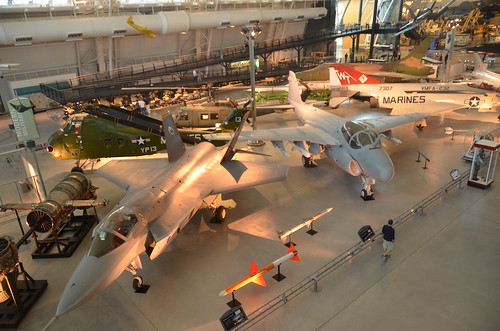
Image by Chris Devers
Quoting Smithsonian National Air and Space Museum | Lockheed Martin X-35B STOVL:
This aircraft is the 1st X-35 ever built. It was originally the X-35A and was modified to contain the lift-fan engine for testing of the STOVL idea. Amongst its several test records, this aircraft was the initial in history to achieve a brief takeoff, level supersonic dash, and vertical landing in a single flight. It is also the 1st aircraft to fly making use of a shaft-driven lift-fan propulsion technique. The X-35B flight test plan was one of the shortest, most successful in history, lasting from June 23, 2001 to August six, 2001.
The lift-fan propulsion system is now displayed next to the X-35B at the Steven F. Udvar-Hazy Center close to Dulles Airport.
On July 7, 2006, the production model F-35 was officially named F-35 Lightning II by T. Michael Moseley, Chief of Employees USAF.
Transferred from the United States Air Force.
Date:
2001
Dimensions:
Wing span: ten.05 m (33 ft in)
Length: 15.47 m (50 ft 9 in)
Height: roughly 5 m (15 ft in)
Weight: around 35,000 lb.
Components:
Composite material aircraft skin, alternating steel and titanium spars. Single-engine, single-seat configuration contains lift-fan and steering bars for vertical flight.
Physical Description:
Short takeoff/vertical landing variant to be employed by U.S. Air Force, U.S. Marines and the United Kingdom, equipped with a shaft-driven lift fan propulsion program which enables the aircraft to take off from a short runway or small aircraft carrier and to land vertically.
Engine: Pratt & Whitney JSF 119-PW-611 turbofan deflects thrust downward for short takeoff/vertical landing capability. The Air Force and Navy versions use a thrust-vectoring exhaust nozzle. The Marine Corps and Royal Air Force/Navy version has a swivel-duct nozzle an engine-driven fan behind the cockpit and air-reaction control valves in the wings to give stability at low speeds.
Other significant subcontractors are Rolls Royce and BAE.
• • • • •
Quoting Smithsonian National Air and Space Museum | Grumman A-6E Intruder:
The Navy’s experience in the Korean War showed the require for a new long-variety strike aircraft with high subsonic overall performance at really low altitude–an aircraft that could penetrate enemy defenses and find and destroy small targets in any climate. The Grumman A-six Intruder was developed with these requirements in thoughts. The Intruder very first flew in 1960 and was delivered to the Navy in 1963 and the Marine Corps in 1964.
The Navy accepted this airplane as an "A" model in 1968. It served below harsh combat situations in the skies more than Vietnam and is a veteran of the 1991 Desert Storm campaign, when it flew missions in the course of the first 72 hours of the war. It has accumulated more than 7,500 flying hours, over 6,500 landings, 767 carrier landings, and 712 catapult launches.
Transferred from the United States Navy, Workplace of the Secretary
Date:
1960
Nation of Origin:
United States of America
Dimensions:
General: 16ft 2in. x 52ft 12in. x 54ft 9in., 26745.8lb. (four.928m x 16.154m x 16.688m, 12131.8kg)
Components:
Traditional all-metal, graphite/epoxy wing (retrofit), aluminium control surfaces, titanium higher-strength fittings (wing-fold).
Physical Description:
Dual location (side by side), twin-engine, all-climate attack aircraft a number of variants.
• • • • •
Quoting Smithsonian National Air and Space Museum | McDonnell F-4S Phantom II:
The U.S. Air Force, Navy, and Marine Corps and the air forces of 12 other nations have flown the multi-part Phantom II. In this aircraft, then a Navy F-4J, on June 21, 1972, Cmdr. S. C. Flynn and his radar intercept officer, Lt. W. H. John, spotted 3 enemy MiG fighters off the coast of Vietnam and shot down a single MiG-21 with a Sidewinder air-to-air missile. This Phantom also flew combat air patrols and bombing missions during the Linebacker II bombing campaign that exact same year.
Later assigned to the Marine Corps, this F-4J was extensively modernized and designated an F-4S. Adjustments included improving the engines (smokeless), hydraulics, electronics, and wiring modifying the wings to increase maneuverability and adding a radar homing and warning antenna, as nicely as formation tape lights on the fuselage and vertical tail.
Transferred from the United States Navy.
Manufacturer:
McDonnell Douglas Corporation
Date:
1958
Nation of Origin:
United States of America
Dimensions:
All round: 16ft 3in. x 38ft 5in. x 58ft 3in., 39999.6lb. (four.953m x 11.709m x 17.755m, 18143.7kg)
Other: 58ft 3in. x 16ft 3in. x 38ft 5in. (17.755m x four.953m x 11.709m)
Materials:
All metal, semi-monocoque structure
Physical Description:
Twin-turbojet (J79-GE-8), two-seat (tandem) fighter / bomber. All metal, semi-monocoque structure. Cantilever, low-wing, monoplane. Dog-toothed top edge of wing (12 degrees), anhedral tail (23 degrees).
• • • • •
Quoting Smithsonian National Air and Space Museum | Republic F-105D Thunderchief :
The F-105 was created as a supersonic, single-seat, fighter-bomber capable of carrying nuclear weapons or heavy bomb loads at supersonic speeds. The F-105D variant was an all-climate fighter-bomber version, fitted with mono-pulse and Doppler radar for night or negative weather operations. The original weapons bay, created for nuclear stores, was sealed and fitted with extra fuel tanks. Bombs had been carried on several weapons racks on the centerline of the fuselage, and on wing pylons. The aircraft was fitted with a retractable in-flight refueling probe. The first F-105D flew on 9 June 1959 and 610 F-105Ds had been ultimately constructed.
This aircraft has served in many F-105 units about the world and is restored to its 1967 Vietnam-era 388th Tactical Fighter Wing, 421st Tactical Fighter Squadron camouflage as it flew in the course of its assignment to Korat RTAB, Thailand. This jet also was briefly assigned to the 355 TFW situated at Takhli RTAB in 1968. Right after this "Thud" completed its combat tour-which undoubtedly integrated missions supporting Operation "Rolling Thunder," "Steel Tiger," and "Barrel Roll"-it returned stateside and began far more than a decade assigned to the District of Columbia Air National Guard and was transferred to the Air and Space Museum in late 1981.
Transferred from the United States Air Force.
Manufacturer:
Republic Aviation Corporation
Date:
1961
Nation of Origin:
United States of America
Dimensions:
Overall: 19ft 8in., 26854.8lb. (five.994m, 12181.2kg)
Other: 19ft 8in. x 64ft 5in. x 34ft 11in. (5.994m x 19.634m x ten.642m)
Supplies:
All metal monoplane, supersonic single-engine jet fighter.
Physical Description:
Single-seat, single-engine, jet, fighter/bomber USAF.
• • • • •
Starting in 1962, the H-34 served as the major Marine Corps assault helicopter of the Vietnam War until its replacement by the turbine-powered CH-46. It started in 1952 as a Navy anti-submarine warfare helicopter evolved from the Sikorsky S-55 series. Initially designated as the HSS-1, it would also go on to see considerable service in the combat assault and utility roles with the Army and Marine Corps. Fantastic Britain and France also deployed versions in some of the first helicopter combat assault operations.
A large payload capacity and generous center-of-gravity range created the H-34 series an powerful transport helicopter for the1950s. Its weaknesses have been a reciprocating engine that struggled in the heat and humidity of Southeast Asia and maintenance intensive mechanical components. This Marine Corps UH-34D never ever served overseas, but wears the markings of Marine Medium Helicopter Squadron 163 that did see in depth combat in Vietnam.
Transferred from the United States Marine Corps
Manufacturer:
Sikorsky Aircraft
Nation of Origin:
United States of America
Physical Description:
All equipment that came with the helicopter that is not attached to it is contained in box A19750823002 with the exception of two items. The VIP steps that attach to the side of the aircraft and the lengthy-handled tool to assist with principal rotor blade deployment are stored inside the helicopter’s cabin.
• • • • •
Quoting Smithsonian National Air and Space Museum | Bell UH-1H Iroquois "Huey" Smokey III:
In 1956, the Iroquois, typically identified as the Huey, very first flew as an Army replacement for the H-13 medevac helicopter of Korean War fame. By the end of the 20th century, Bell had made a lot more Hueys than any other American military aircraft, except for the Consolidated B-24. Superbly suited to the air mobility and health-related evacuation missions in Vietnam, the Huey became an indelible symbol of that conflict.
This UH-1 compiled a distinguished combat record in Vietnam from 1966 to 1970 with four units, like the 229th Assault Helicopter Battalion of the 1st Cavalry and the 118th and 128th Assault Helicopter Firms. Numerous patches on its skin attest to the ferocity of missions flown whilst operating as a "Smoke Ship," laying down smokescreens for air assault operations with the 11th Combat Aviation Battalion.
Transferred from the United States Army Aviation Museum
Manufacturer:
Bell Helicopter Organization
Date:
1966
Nation of Origin:
United States of America
Dimensions:
Rotor Diameter: 14.7 m (48 ft 3 in)
Length: 12.6 m (41 ft 5 in)
Height: 4.two m (13 ft 7 in)
Weight, empty: 2,580 kg (five,687 lb)
Weight, gross: four,309 kg (9,500 lb)
Supplies:
General: Metal airframe, plexiglass windows.
Physical Description:
Utility helicopter, two-blade major and tail rotors, powered by a single GE T-53L13BA turbo-shaft engine. There are oil stains on the reduce aft fuselage and beneath the tail rotor gear box. The horizontal stabilizer was removed.
(Source from China rapid prototype company blog)

No comments:
Post a Comment